
Pippen, Rodman and Davout: What the "other guys" teach us about success and meaning


Michael Jordan was and is the most iconic basketball player of all time. From 1991-1998 his Chicago Bulls won six out of eight NBA championships. Twice the Bulls won three championships back-to-back-to-back in 91’, 92’ and 93’ and 96’, 97’ and 98’, creating an era of basketball dominance unequaled since. His name, his shoes and his brand have traveled all over the globe. His classic mid-air silhouette is instantly recognizable whether you are in Seattle or Shanghai, Chicago or Chile, New York or New Brunswick.
But basketball is a team sport. Four other players took the court alongside Michael Jordan as the Chicago Bulls fought their way through the regular season, Western Conference playoffs and NBA Finals year after year. Among those players Scottie Pippen and Dennis Rodman stood out as his most consistent and valuable teammates. He depended on them in very different ways. Scottie Pippen was more like Jordan in both temperament and ability. Scottie Pippen was one of the most athletic players to ever touch a basketball. On offense he was a dynamic jack-of-all trades. He could score, playmake, pass, shoot and rebound. Yet it was his defense that he was known for. Quite often Pippen was tasked by coach Phil Jackson with guarding the other team’s best player. His 6’ 8” frame coupled with his freakish athleticism and toughness left his opponents no clear weaknesses to exploit.
It would be simple enough to say that Scottie Pippen was a well-rounded versatile basketball player, but that doesn’t do justice to how great he was. In 1994 Scottie Pippen became the second player in NBA history to lead his team in every major statistical category—points, rebounds, assists, steals, and blocks over the course of a season. Since 1994 only four other players have ever accomplished this feat: Kevin Garnett, Lebron James, Giannis Antetokoumpo and Nikola Jokic- truly elite company. For the NBA’s 75th Anniversary in 2021 a panel of reporters, current and former players, coaches, general managers, and team executives selected the 75 greatest players in league history. Of all the players in the league’ storied past Scottie Pippen was placed at number 32. Very few people have ever played basketball better than Scottie Pippen.
Perhaps just as integral to the Bulls’ success during their second threepeat was power forward Dennis Rodman. Rodman possessed one of the most unique skill sets of any professional basketball player in the history of the game. Offensively he was no Scottie Pippen or Michael Jordan. He was never a great shooter or playmaker. But where Dennis Rodman shined was on the boards. There is a strong case that can and has been made that Dennis Rodman was the greatest rebounder in the history of the NBA. During his three championship seasons with the Bulls, Rodman averaged over 15 rebounds a game. Considering that over the course of an average NBA game of that era each team possessed the ball some 94 times, Rodman’s rebounds generated tremendous value for the team. After the 1996 Finals in which Dennis Rodman had two games with a record-tying 11 offensive rebounds, Seattle Supersonics coach George Karl credited Rodman as the defining factor in the Bulls victory, "As you evaluate the series, Dennis Rodman won two basketball games. We controlled Dennis Rodman for four games. But Game 2 and tonight, he was the reason they were successful." Like his rebounding, Rodman’s defensive abilities were also the stuff of legend. Over the course of his career Rodman would be selected to 8 All-Defensive NBA teams and be named NBA defensive player of the year twice.

Without Scottie Pippen and Dennis Rodman by his side Michael Jordan would not have won six rings. That statement is not meant to be a slight against Jordan’s own talent and abilities. Michael Jordan is arguably the greatest basketball player of all time and there is only one other player who there is even an argument for placing above him. Simultaneously we must acknowledge that Michael Jordan's success was also contingent on others and especially Scottie Pippen and Dennis Rodman. From an even broader perspective you could point to other role players on the Bulls roster like Steve Kerr or Toni Kukoc who hit crucial shots in big games or the Bulls’ coach, Phil Jackson, who kept a diverse team of contrasting personalities on task and argue that they were also indispensable in their own unique ways.
But of course, the average person, even the average American, is largely unaware of the contributions of these “other guys”. Unless you are an avid basketball fan or happened to watch The Last Dance on a whim, the extent of your knowledge surrounding the Bull’s dynasty is mostly limited to the singular figure of Michael Jordan. And truth be told this is how most success stories are perceived.

Napoleon Bonaparte, like Michael Jordan, is another name that is instantly recognized all over the world. Napoleon shaped an entire era of European history. His dynamic and charismatic leadership propelled France to dominate nearly the entire European continent. The reforms made to French law during his reign, known today as the Napoleonic Code, became one of the most influential documents in human history. The Napoleonic Code emphasized clarity and accessibility in contrast to the vague and tedious patchwork of feudal laws which came before it and was written in the vernacular. Napoleon’s reforms left a mark on legal systems from Latin America to the Middle East. However, no biography of Napoleon would be complete without mentioning his achievements on the battlefield.

It would not be wrong to say that Napoleon Bonaparte was the greatest military leader to ever live. His stunning campaigns in Italy, Austria and Prussia are among the finest examples of military leadership in the modern era. Almost always outnumbered and facing enemies from every direction, divide and conquer became Napoleon's strategic maxim and necessity. Time and time again his lightning movements stole the initiative from his opponents and enabled his armies to destroy his enemies in detail before they could coalesce.
But for the Grande Armée to even be capable of this style of warfare many crucial elements had to be in place. First the doctrine and organization of the Grande Armée had to enable Napoleon to enable him to quickly and decisively come to grips with the enemy. European warfare before the Napoleonic era was mostly a system of positions, in which both sides did more watching and waiting in camp than actual fighting. In part this was because armies fought and campaigned as a single, whole entity concentrated for both movement and battle. As Major James Wasson states in his article The Development of The Corps D'Armée And Its Impact on Napoleonic Warfare:
“[During the 18th Century] an army had no sub-structure higher than the regiment and was therefore a pondering beast that generally moved along one route. Subdividing the army into separate regiments might allow an adversary to overwhelm the separate parts piecemeal. This concentration during movement caused the army to move slowly and allowed its opponent to determine, with relative ease, its objective. Supplying this type of army required huge depots, which tended to keep the army on a "short leash" from its supply base.”
Napoleonic warfare was characterized by "...its limitless variation and flexibility." Napoleonic warfare was quick and bloody, and sought a decisive engagement. Napoleon's army dispersed to move along separate routes and concentrated to fight. The French army of 1806 was not tied to large immobile depots for supplies, but lived off the land as it moved. This allowed the new armies to move, not only faster and farther, but to change direction quickly. Napoleon's...insistence on speed and mobility was a basic feature of the Emperor's campaigns from beginning to end and was the feature of his warfare that most confused and unsettled the majority of his opponents, brought up in a tradition that taught a more leisurely type of warfare. The ability to disperse and concentrate rapidly, and to advance on several routes "...allowed Napoleon to do something [earlier] armies could never do--force engagement."
In 1800 Napoleon reorganized the French army into six corps. Each corps was a self-sustaining apparatus, each with its own headquarters and administrative staff, logistical support and fielded a combined arms force that both countered and posed a variety of threats. Corps could thus operate independently of each other, freeing Napoleon from the ponderous singular mass that typified earlier armies.
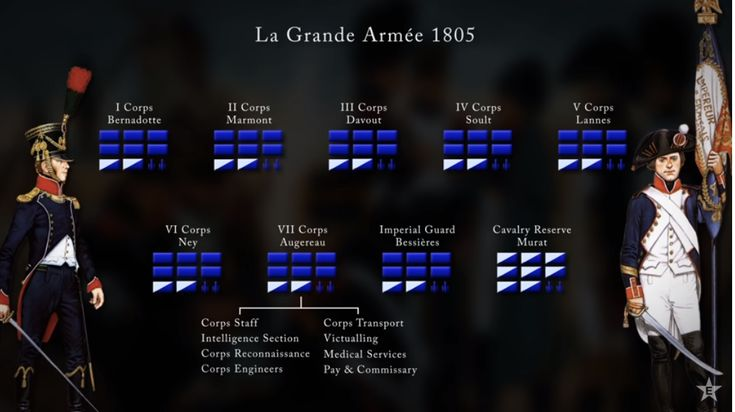
Though Napoleon was the implementer of these ideas he was not the original proponent. Jean de Bourcet and Jacques Antoine Hypolite, Comte de Guibert, were military thinkers who served the Bourbon monarchy in the Seven Years War and saw the need and potential for dramatic change in the conduct of military campaigns. Their writings, particularly Essai général de tactique by Guibert and Principes de la guerre de montagne by Bourcet espouse many of the principles that Napoleon used in his reorganization project. Without the influence of these critical military theoreticians Napoleon would not have had the vision to create his new fighting system. With it he won battle after battle.
Napoleon’s reorganization also showcased the talent of his subordinates. Because each corps was capable of and engaged in independent actions, Napoleon expected his corps commanders, known as Marshals of the Empire, to be semi-autonomous leaders who would make their own decisions on how to accomplish their broader objectives. Napoleon’s marshals had a much higher degree of responsibility and freedom than their peers because they were both encouraged and expected to adapt their orders to the specific situations they encountered.

Of all the marshals Napoleon selected during his reign as emperor, Louis-Nicholas Davout ended up proving to be his wisest choice. At the time of his appointment Davout had been the youngest and least experienced of all the generals promoted to Marshal of the Empire. Many thought Napoleon had made a grave mistake. Yet Napoleon had seen Davout’s talents firsthand during his expedition in Egypt and was certain that he was made of the right stuff. Not even Napoleon could have known just how magnificent Davout would prove to be in the years ahead. Of all his impressive achievements, it was Davout’s performance at Auerstädt that cemented his legacy forever.
On October 9th, 1806, Prussia joined the anti-Napoleon alliance of Russia, Saxony, the United Kingdom and Sweden, setting off the War of the Fourth Coalition. Napoleon responded by doing what he did best. The Grande Armée was ordered east across the Rhine on a mission to knock Prussia out of the war before the rest of the allies could provide assistance. Less than a week later, on the 14th, after emerging from the Franconian Forest in northern Bavaria, Napoleon came to grips with the Prussians around the town of Jena. Believing he was facing the main body of the enemy, Napoleon sent orders to both Davout and Marshal Bernadotte to reunite with him at once. Davout attempted to comply by crossing the Saale but ran right smack into another Prussian force on his way south. Near the small Bavarian town of Auerstädt Davout’s 26,000 strong III Corps had walked into the largest element of the Prussian army. 64,000 Prussians were now poised to annihilate III Corps where it stood.

While Napoleon fought the Prussians at Jena with a hefty advantage, Davout was scrambling to make a desperate stand. Outnumbered by more than 2:1, Davout’s only realistic hope was to hold out long enough for Napoleon to come to the rescue. As Prussian infantry donned their peaked schirmmutze caps and shouldered their muskets and as cavalrymen fastened their cuirasses and inspected the sharp edges of their sabers one last time in the faint morning light, Davout resolved to do just that. The battle that resulted was among the most savage fought in the Napoleonic wars.
The Prussians initially tried to surprise Davout by attacking through a fog that enveloped the battlefield, falling on the French right flank and rear. Davout’s men formed defensive squares and managed to fight back. Prussian losses mounted until finally they retreated in disarray. By 8:30 in the morning nearly all of III Corps was engaged. At a critical moment in the battle the Friant division arrived which Davout used to relieve pressure on the French defensive positions in the village of Hassenhausen. Both Davout and his counterpart, the Duke of Brunswick, considered holding Hassenhausen to be essential, and began pouring reinforcements into the area. The fight in the streets was fierce, devolving into hundreds of smaller struggles as French tirailleurs and Prussian fusiliers shot and stabbed each other in gardens, houses, yards and alleyways just to advance yards, feet or even inches.
The French held despite a last-minute scare. 10,000 men under Prince William VI of Orange Nassau fell upon the weak French left wing south of the village and began to roll up Davout’s flank. Davout was barely able to fend off this new assault with Morand’s division, which arrived amidst the chaos and swung into action, blunting the momentum of the Prussian infantry and saving the French line from crumbling.
The battle lasted until mid-day. After the Prussian center shattered from a French counterattack, King Fredrick William III, disappointed by the events of the day and recognizing his now perilous situation, told his men to pack it up.
In the aftermath of the twin battles of Jena and Auerstädt, it was not immediately obvious to the French participants whether Davout’s III Corps or the rest of the Grande Armée had done the lion’s share of the fighting. Napoleon’s ego told him that he had borne the greater burden. But once the dust settled it became clear that Davout’s defense was nothing short of a miracle. In the words of historian François-Guy Hourtoulle, “At Jena, Napoleon won a battle he could not lose. At Auerstädt, Davout won a battle he could not win".
What Scottie Pippen, Dennis Rodman and Louis-Nicolas Davout all have in common is that they were indispensable but not primary factors in successful enterprises. Despite their considerable talents, most will never care to learn what they did and who they were. Whether consciously or not, the majority of people will credit the success of the Chicago Bulls in the 90s and the Grande Armée in the early 19th Century to their celebrated leaders, Michael Jordan and Napoleon, if they think of them at all.
Yet hundreds of employees and players passed through the Chicago Bulls franchise during Michael Jordan’s tenure and hundreds of thousands of men fought under Napoleon’s banner. We don’t know their names; we can’t recognize their faces or silhouettes. We might be tempted to believe that they didn’t matter. We might be tempted to believe that unless our name ends up in newspaper headlines and internet searches that we don’t matter.
The internet age and the birth of social media has done nothing but drill this idea into our heads. Clicks, views and shares are the new currency of the digital age. They are the new marker of success in a world of consumers hungry for the next source of entertainment and desperate to drown out the underwhelming reality they experience. Every day millions of accounts across cyberspace shout examples of success at us and tell us how to create more fulfilling life for ourselves. Get up early, go to the gym, meditate, read books, learn stocks, get into real estate, start a business, etc., all with the singular goal of becoming “The Man” or “The Woman”, the badass alpha predator we were meant to be.
Of course, none of these pursuits are bad in and of themselves, in fact quite the opposite is true. In many cases they are healthy and productive things to do. The problem is the overarching goal is flawed. Not all of us are meant to be primary actors. Not all of us are meant to be a Michael Jordan or a Napoleon Bonaparte. Scottie Pippen, as great as he was, tried to lead the Chicago Bulls to another ring during Michael’s year off in ‘94 but couldn’t finish the job. The question then became, when Michael returned, would Scottie let him take back the mantle and the burden of being the top dog. Scottie eventually did and the Bulls won three more rings.
But it hurts our ego to admit that we aren’t the top dog. To this day Michael Jordan and Scottie Pippen, two of the winningest teammates in NBA history, are not on speaking terms. While there are a myriad of personal conflicts that led to this point, there is no doubt that Michael Jordan’s overwhelming fame in contrast to Scottie Pippen’s cultural irrelevance is largely to blame.
Perhaps jealousy and envy are the purest expressions of our desire to be number one to be "The Man" or "The Woman". To be the lords of success wrought by our own hands. To be the lords of our own skull-sized kingdoms. Yet how many countless times have we seen the pursuit of success, status and wealth destroy the pursuers.
What comes to my mind is Daniel-Day Lewis’ character in one of my favorite movies There Will Be Blood, and how he continuously manipulates people to his advantage all the while growing his oil empire and amassing great riches. By the end of the movie his character spends his days wandering aimlessly around the halls of his vast and gloomy mansion. The only human interaction he has is with his servants and others on his payroll. He has burned all his bridges. There is not a soul left on earth that cares for him, for he has driven all that did away. Death is now a welcome end to his misery.

Truth be told, Daniel Day-Lewis’ character did what most of us do every day. He confused the vestments and trappings of wealth, fame and success with inner fulfillment and meaning. He discovered too late that he had wasted his life.
I believe that every single person on earth has a purpose. That purpose is for each and every one of us to discover ourselves. No one can do it for us, and no amount of recognition or wealth can alter it. It is only when we begin the pursuit of our purpose that we can derive true fulfillment. For most of us that means realizing that we are not a Michael Jordan or a Napoleon, instead we are a Pippen or a Davout, maybe even a Phil Jackson or a Jean de Bourcet. We may resist this calling, but if we do, we only disrupt the greater units we are a part of in life and discredit ourselves and our contributions, in the process making our own little corner of the world that much worse. If Jordan had tried to be a Rodman or Davout a Napoleon, the whole enterprise would have suffered.
So instead, I urge you to do the opposite. Find what is in you to do and then do it with all your might. It matters more than you can possibly imagine.
“If you are what you should be, you will set the whole world ablaze!” -St. Catherine of Siena


Comments